Easel 15 - Spring 2007
A selection of articles
Editorial
This issue addresses with great passion the question posed in the previous edition - “What is Art?” Don’t miss a word! Additionally, poetry and the script for a short play showing the influence of Samuel Becket, is indicative of the vast range of creative talent in our art society.Humour, too, is not in short supply. We are sad to announce the deaths of Val Jackson-Huet and Raymond Wright, who joined the Society about a year ago, Raymond died on Christmas Eve, Val at the end of November.
From The Exhibition Secretary
In 2006 exhibitions resulted in poor sales overall with the exception of many solo exhibitions which did well. I feel 2007 will be similar. However, our increased membership with more members exhibiting is resulting in more interesting shows. There is a sense of excitement in all this. We are a well established, well regarded society thanks to the efforts of many members not afraid to experiment, inovate and move on. Sales are not the be all and end all of an exhibition – agree?
In an effort to entertain the public we are actively looking for new venues and new ideas. From mid-January to March the Wednesday group exhibited in Orpington Hospital – just 34 paintings from 17 artists. The hospital feels that this show is a morale booster for patients and visitors. We hope to repeat this exercise elsewhere. Small scale exhibitions, perhaps over a weekend only, will hopefully be in addition to our regular exhibitions of a week or more. New ideas and venues are needed – you can help here. Why not lay on your own exhibition in your own home, perhaps with one or two other artists? The society will help with promotion and advice.
I could go on in this vein but the underlying message is this – more participation from more members is needed – this means YOU.
Good luck, more fun and excitement to us all in 2007.
Peter M Dinsmore
From Your Chairman
Happy New Year to everyone and may you have as lovely and interesting year of talks, demonstrations and exhibitions as in 2006. We had a very enjoyable social evening at the beginning of December. There were good refreshments and a stall of attractive items arranged by Ann; a splendid book- stall and auction by Peter (which involved a great deal of fetching and carrying and lifting); Chris. organised a raffle for one of Charles Evans’ paintings; Allan displayed the prints of members’ palettes and I arranged a quiz. So a very good time was had by everyone. On December 13th we had a very convivial lunch in the dining room of the Ripley Art Centre. Thanks go to Joe Grimaldi for arranging the food and Peter for the drinks. We are continuing our Wednesday afternoon workshops at Ripley this year, 1.30 p.m. to 4.30 pm.
Pat Tucker
Own Art with an Interest Free Loan
(Available at selected contemporary art and craft venues across England.)
Following up on my article in the Easel in 2006 you can now pick up a leaflet at your local library with full details of this scheme and participating galleries in the South East of England. Interestingly enough, the front cover of the leaflet depicts a shirt with a map of England on it so maybe the ‘shirt’ featured in the copyright talk and Easel wasn’t so far fetched. Our nearest participating gallery is Frances Iles Gallery in Rochester Kent, so this may be worth investigating further. I did once exhibit there. It must have been an open and I cannot remember how I got to hear about it so it¹s worth checking this out and their web site at artycat.com To apply you must be over 18, hold a bank account that can handle direct debit payment and you need two proofs of identity. there is no administration charge or handling fee. Own Art also offers the possibility of commissioning a custom made item from the artist. You can borrow up to £2,000 or as little as £100 and pay back the loan in ten monthly instalments - interest free.
Ann Holdway
Exhibition Rules
I hope many of you will be sharing your thoughts on this subject. Here are mine.
- I sometimes get inspiration from someone else’s painting but I don’t consider what I produce to be a copy because it¹s my interpretation, my style, my colours, so where do you draw the line?
- As far as I am aware all prints we receive are identified and numbered.
- All work needs to be for sale, no problem with this one either way and some people may just like to have their work on show.
- Do not agree with a minimum price the artist needs to feel comfortable with the price they are charging.
- Some canvases do not need framing, so this cannot apply.
- Could apply to our main exhibitions but not our one day sales, etc.
Over to you. I’m looking forward to reading some witty and entertaining replies.
Ann Holdway
What is Art?
In Easel 14, Allan posed the question "What is Art?"
Allan's own notes are below, followed by three contributions from others in various forms ....
If you have children or grandchildren at school, the ‘Student Hanbook for Art & Design’ by Richard Hickman at £3.95 from Pearson Publishing, 2002, ISBN 1 85749 637 X is a book that provides support, advice and up-to-date information about art and design at Key Stages 3 and 4, and GCSE. The National Curriculum for Art and Design places emphasis upon three connected areas - understanding art, knowing about art, and making or creating art. This handbook is based on these three areas.
“Traditionally, there are three main ideas about what art should be, with related ideas about how it should be judged:
- Art should be based on imitation. It should look like something or represent some- thing; the more realistic it is, the better the art.”
- Art should be concerned with feeling and expression; the more it conveys feeling the better it is.”
- Art should be concerned with the interesting arrangement of visual elements. The most successful art is that which has the most ‘significant form’, ie the most interesting arrangement of shape, colour, etc.”
(Note: I recommend this little handbook with equal weight to both novices and those who consider themselves to be experts. Wonderful stuff! Ed.)
What is Art? - John Evans
Dear Allan,
Replying to your thought provoking Easel-hung shirt I would say that
too seriously discuss whether it is or is not Art would take a long
time and bore your readers to death. Suffice to say that by the
examples you mention and the definition in my dictionary the answer is
yes but should be no!
I much prefer your “wasted opportunity” on the back cover.
Rather than prompting discussion however, the Easel stimulated me to
action. The result is the enclosed and when it was finished I decided
an appropriate title would indeed be “Stimulation”.
Now I am not so sure for I discern a somewhat unfortunate juxtaposition
of the hand at the bottom of the picture. If this had been intentional
it might have been rather clever but it wasn’t!
Regards,
John Evans
(STIMULATION is on the front cover. Ed.)
What is Art? - Dianne Gilmour
Two to three nano-seconds after our first meeting Allan Davies asked me
if I would write an article for this edition of ‘The Easel’.
“O.K.,” said I, “What about?” “What is Art?”
“Oh, that old chestnut. Eezy Peezy lemon squeezy - I know THAT!” So
here it is - the definitive, complete and utter answer to the question
What is Art?.
Art is:-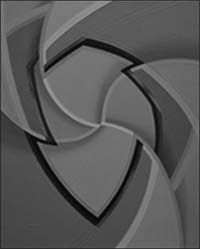
Looking at a portrait in the current Holbein exhibition and realising that you’ve just seen that person on the tube.
Sitting in the Rothko room at Tate Modern and feeling totally awestruck without knowing why.
Anything by Rembrandt.
“My Mum and a Carrot” by Jade, aged 5. (Collection of the artist).
John Singer Sargent’s watercolours.
A Thierry Henry goal. (This was my teenage son’s suggestion and is included under the umbrella term of Performance Art.)
The Sistine Chapel ceiling.
Finding something to like among the 2006 Turner Prize contenders. Honest! Check out Tomma Abts.
Rolf Harris. Anyone who can get seven million plus people to watch a programme on Rodin has to be a bit special.
That moment when you’re painting/drawing/sculpting or whatever it is
you do when something just HAPPENS. Just for one fleeting moment you
have an insight into how every artist in history has felt. MAGIC.
So there it is. Art. Sorted.
Now - the Meaning of Life....
Dianne Gilmour (New BAS member)
Note: This was submitted well before the winner of the Turner Prize was announced. Ed.
What is Art? - Keith Burtonshaw
There once was an artist unknown
whose painting resembled a stone.
“It’s abstract,” he said,
“it’s a young lady’s head
with nothing to see but the bone.
But why are the features left out
and a few scribbly lines strewn about?
“They show an idea in my mind
that imagines an image of kind.
But if onlookers cannot see this,
how can they know what it is?
“It’s the title that tells us,” he said,
as he woke from his dream in his bed.
“But without a title I’m sunk,”
he thought as he sat on his bunk.
Keith Burtonshaw
Interview - Bernard Victor
How long have you been involved in BAS ?
Since 2004 when I heard about it from my then tutor, Chris Nash, who I believe had some connection with the society.
What has been the most satisfying of your artistic achievements ?
I expect selling my first painting, and realizing that someone else liked my work outside of my immediate family and friends.
What other passtimes do you have outside painting?
I like listening to jazz and classical music, and have been a jazz fan since I was 12. Messing around on my computer. I used to sail dinghies and have always been a railway enthusiast. Before I retired in 2000 I ran a specialist model railway shop, which really combined hobby and business. I read a lot anything from crime to biography, and like going to the theatre.
What made you want to be an artist?
At school I was keen on art, and got a GSCE, but my parents would never have considered me going to art school. I've always loved going to galleries and some of my wife’s family were involved in the art world, so when the prospect of retirement loomed I made up my mind that I would have another go at painting. I took a ‘get started’ course at the Thomas Calton centre, and then was introduced to Dulwich Painters, where we have an unstructured tutored group. I have taken various courses, and also regularly attend the Strand Studio Club, an untutored life group.
What is your favourite place?
Dulwich where we live. It is an oasis in the heart of London.
What is your definition of Art?
In the broadest sense, something creative produced by a person or persons which gives pleasure to other people, whether it is painting, music, writing, cooking etc., etc. Great art is where that creation is timeless, like a Mozart concerto, a Rembrandt painting or a novel by Tolstoy, and not something ephemeral like so much modern painting, sculpture and music. Will Tracey Emin or Take That be known in 100 years time?
Who are your favorite painters, and who do you feel have influenced you?
The list would be too long, but as well as the usual favourites , like Rembrandt, Monet etc., there are some perhaps lesser painters whom I like and have been of some influence, Boudin, Pissaro, Mondrian, Barnett Newman, the Scottish Colourists, Euan Uglow. The greatest influences though are Cezanne and Matisse.
What would you say to someone who has recently found pleasure in art to encourage them?
Have a go ! Go to a good beginners class to learn the basics. Do your own thing and try not to just copy other people’s work because you think they are good. Get straight into oils, gouache or acrylics, and not touch watercolour until you are reasonable proficient, it is so frustrating not being able to correct your mistakes. I think so many beginners get fed up and give up because watercolour is such a hard medium to work in. Draw, draw and draw. Even if you want to paint abstracts being able to draw is still essential. Go to galleries - not just the block- busters but shows like the ones at the Mall Gallery and watch other artists at work.
Interview - Brenda Sayburn
How long have you been painting?
I have drawn and painted for as long as I can remember. As a child I loved ‘colouring in’ with my treasured box of Lakeland Derwent pencils and Reeves Students’ paintbox.
Who or what was your main inspiration to paint?
I had an excellent art teacher in secondary school. She introduced us to all of the media, opaque and transparent, pen and wash, landscape (in nearby Crystal Palace Park) and then on to life drawing at Bromley Art School which, at that time, was at the corner of Widmore Road and Tweedy Road. The same teacher was great on the history of art and on art appreciation and her lessons were supplemented with visits to the Royal Academy, National Gallery and the Tate.
Which medium do you prefer?
I did a lot of crafts when my children were young but then I went to watercolour classes in Kemsing which started me off painting again. More recently I’ve enjoyed pastels and now acrylics, having been to a few short courses. I like the opaque quality of acrylic and feel more relaxed being able to cover mistakes or changes of heart.
What inspires you to start a picture?
Either sentiment for a scene or a place that I know very well and which means a lot to me, or because I fall in love with the atmosphere of a place and for which a photograph is not enough. An example of the latter is the Callanish stones in the Outer Hebrides with the magical shapes and atmosphere. Examples of the former are Whitley Bay island lighthouse for its holiday memories and Cambridge because I learnt to love it whilst living there for several years.
What advice would you give to a new painter?
As well as membership of the B.A.S, I would suggest a class for mixed media painting and, ideally, another for life drawing. Then I would suggest he or she attend as many galleries and exhibitions as possible in order to get a wide overview of styles of picture-making.
Which galleries?
Well, I love the Mall Gallery. Its series of exhibitions is many and varied. It is small and friendly with low or no admission prices. During the next few weeks one can see exhibitions by The Wapping Group, The Pastel Society, the Royal Institution for Painters in Watercolour and the Royal Society of Portrait Painters.
At the national exhibitions in London we have recently been treated to Rodin, Velas- quez, Holbein and Hockney and will soon be able to see Hogarth (Tate Britain) and Canaletto (Dulwich) and many others.
What does B.A.S. membership mean to you?
I particularly enjoy the variety of subjects that are covered in the lectures and demonstrations. I attend whenever I can, whatever the topic, and am frequently entertained and informed about new aspects of the wider art subjects. In addition, I find members are very nice and friendly and enjoy the social side of the meetings. I do not really want to exhibit to sell at the BAS shows as, if I paint a picture that is worth framing, then I generally want to keep it.
That Wow! Factor
On a recent weekend I visited two art exhibitions, one put on by my local art club and the other by a group of professional artists. On thinking about them afterwards I realised that whilst the amateur show had many 'nice' paintings, and showed a high level of painting ability, the professional show had many more paintings that had that 'wow' factor that made more impact. They claimed your attention, even though you might not actually like them. I have tried to work out why the pro's paintings had that impact.
The first thing that struck me was the medium used. Most of the amateur paintings were in watercolour whilst the pro paintings were mostly oils or acrylics. Why do most amateurs paint in watercolour? When I started painting, after I retired, I was told by two retired art school tutors not to attempt watercolour but to start with oils, as that way I would learn to paint properly, and only when I was reasonably competent should I attempt watercolours. I am sure that this advice has paid off. It is much easier to correct mistakes and not get frustrated.
Another factor was size. The majority of the pro paintings were larger and not always on standard canvases, whilst the amateurs generally kept to small standard sizes, which had less impact. This also affected presentation. The club painters were mostly mounted and framed, often the frames or mounts were poor and not much thought had been put into their suitability for the painting. Quite a few of the pro paintings were on deep edge canvases allowing them to be hung without frames or even when not on deep canvases were painted on canvases tacked from behind so they could still be framed or hung without frames. Where they were framed much more care had been taken in the choice of frame to suit the type of painting, even to the extent of painting the frame to match the painting. One has only to look in an estate agent’s window to see that a lot of home owners like unframed or deep modern framed paintings instead of the traditional gilded framing.
The choice of subjects was similar, except there were very few club painters who attempted abstracts. It seems very few amateur painters are drawn to abstraction and when they do they tend to be very stiff. The pro's paintings were generally brighter giving them more impact. Looking at many instruction books this seems to be some- thing that is not stressed and again is possibly caused by the use of watercolours.
Another cause of this lack of excitement in a painting is the use of photographs being used as the subject. It is often stressed in painting articles that a photograph should only be used as reference, and a painting based on sketches will have more impact. One has only to go to any club painting session or even a painting class to see that many people are trying to copy from photographs, often without even making preliminary sketches based on the photo. Even some pro's do this and it nearly always results, even when done with a great amount of painting skill, in a dull and lifeless painting. Possibly the club painters sold just as many paintings, but I do feel that tutors should stress the importance of impact on the viewer as well as just how to paint in a competent manner.
Bernard Victor
Watching Paint Dry
“D’you think it’s dry yet?”
“Dunno.”
“It took three hours yesterday.”
“Yeah.”
“Still, it was a warmer day. The day before, I mean.”
“Yeah, but not as warm as last week.”
“Yeah, it was warmer last week. D’you like the colour?”
“No.”
“I wanted blue but they would have this orange-red.”
“It’s more reddish orange.”
“Yeah. Whatever.”
“I like green.”
“Green’s more serviceable, I suppose.”
“Yeah.”
“Kandinsky said ‘green is like a fat, very healthy cow lying still and unmoving, only capable of chewing the cud, regarding the world with stupid dull eyes.’”
“A bit like your old woman.”
“Yeah.”
“I rather lean towards Paul Klee’s jactitation ‘Colour possesses me. Here is the meaning of the happy moment: colour and I are one. I am a painter.’”
“We’re both painters, mate. That’s what it said on the job description. They insisted in orange-red. It said sunset on the tin.”
“I ain’t never seen a sunset that colour. Well, not in Peckham.”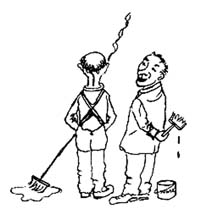
“D’you think it’s dry yet?”
“Might be.”
“Want a fag?”
“No.”
“‘Ow long has it been now? I mean, since we done it?”
“Dunno. You talk too much.”
“Sorry. I mean, sorry if I talk too much.”
“There you go again. Shut up!”
“All right. D’you think it’s dry at the bottom?”
“I doubt it. We started at the top.”
“‘Ow long do we have to stay here?”
“Until it dries.”
“When will that be?”
“’Ow do I know?”
“D’you think it’s dry yet?”
“Dunno.”
Jill Reardon
Joe Goes to Paris
What could have been easier than catching the Eurostar to Paris? After a comfortable three hour journey we arrived at our destination and using a 'Paris Visite' travel pass we enjoyed unlimited travel on bus and metro to see the sights. The highlight of our stay was the Musee L'Orangerie, home to Claude Monet's outstanding Water Lilies Sequence. After 6 years of renovations the Orangerie reopened its doors to display Monet's giant panels in two oval rooms forming an infinite elipse. Daylight bathed the water lilies in natural light as was originally intended and ninetyone metres of canvas recreated the three dimensional effect of reflections and light on water. Altogether thoroughly inspiring.
Joseph Grimaldi
True Colours
Dear Artist,
There are colourists and there are colourists. There are those among us whose colours are clunky and crude--and there are those whose colours are deadly, tasty, and "right on." There are even some, like Paul Gauguin, who believe colour ought to be arbitrary--that is, it's a good idea if the sky is green and the grass is red.
While we're at it, there are those who think tone values are more important than hue--which is similar to saying colour is arbitrary. But even newly baptized novices know that if you manage to get the right colour your painting can look "true." God may work in light, but we mortals work in pigment. Getting the colour of the light through haze in front of a distant range of hills is, for many, the Holy Grail. It's not in the magic of some new pigment, it's a matter of looking, seeing, mixing, testing and adjusting.
Looking is opening your mind to your impressions. Seeing is replacing what you know with what you see. Mixing is the knowledgeable confluence of pigments. Testing is comparing your preparations with the truth. Adjusting is the will to fix your flagrant wrongs.
Guidelines for mixing: I know it's basic, but where you mix your colours (your palette) won't show how a chosen hue will react with others on the work itself. You must apply and consider. Also, many successful mixtures contain a mother colour, plus white and black. Don't be afraid of black. Having said that, garishness, when it occurs, is best neutralized with its opposite on the colour wheel. Get a colour wheel. And when you come to mixing, testing and adjusting, it's nice to know that practically everybody must silently and diligently struggle to get it right. There's no easy way. In the words of Chromophobia author David Batchelor, "Colour reveals the limits of language and evades our best attempts to impose a rational order on it. To work with colour is to become aware of the insufficiency of language and theory - which is both disturbing and pleasurable."
For those who paint outdoors, colour work can seem devilishly programmed to perplex and confuse. On the other hand, film photography, with its errant chem- icals, can also get things wrong. Digital reference material, because of its eternal tweakyness, has been sent by the Great Goddess to help us look more virtuous than we are.
Best regards,
Robert
This is an example of the twice-weekly e-mail letter from Canadian artist Robert Genn - published here with his permission.The letters are free to anyone who subscribes and subscription is free, too. The web page is worth visiting regularly at www.painterskeys.com. Thank Bernard Victor for the contact. Ed.
We Never Knew Who We Were Going to Meet
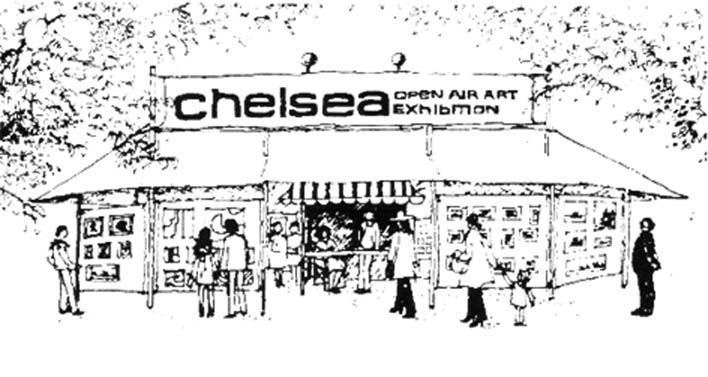
From the mid 1960's right through to the 1980's for each Saturday throughout those summers, I went to the Kings Road to exhibit in the Chelsea Open Air Art Exhibition. The family came too. It was the period which came to be known as “The Swinging Sixties” and the Kings Road was at its centre. One never knew who we would meet, or just see passing by, next. It was a fun place to be and provided a welcome contrast to our normal suburban lifestyle. There were celebrities to recognise amongst the flower people and later amongst the punks, but this colourful, vibrant mix was never threatening.
I want to tell you of one particular experience which happened on one of those Saturdays in 1983. After looking at my exhibits a young American man asked me if I would be willing to paint a picture of the house of a friend. Of course I said yes - it is what I did. In those days most of my commissions were for painting houses in the Chelsea area and I assumed this to be just another of these. He then introduced me to his “friend” - it was soon apparent that the friend was actually his employer and he was Sheik Salim’s PA and minder. The Sheik was dark haired, even more handsome than the first man, he wore an emerald green silk shirt and tight white trousers and had been educated at Eton.
It was then that I was told that the house was near Luton and could I come to look at it that afternoon. There was a problem; our daughter Louise was with me but had gone for a walk with a boy friend and would not be back before 6pm when the show closed. They said they could wait as they also had to wait for their girl friends to emerge from their hairdressers.
Husband Leslie was rung and told that we would be late home, the two glamorous girl friends appeared and so did Louise. We set off squeezed into a white open- topped sports car. Just short of our destination Salim stopped the car and insisted one of the girls took over for the rest of the way. She was petrified but apparently could not refuse. To add to her nerves he sat on the bonnet and pointed the way.
We all arrived safely. The house was large with a beautiful garden and distant views over the surrounding countryside. Internally the furnishings were immaculate. I was taken round the outside of the house and two external viewpoints were agreed. He also wanted an interior of the main living room. On arrival a cook and maid were waiting to serve us with cocktails and sweetmeats, but there had been no sign of any cooking.
After a short time they offered to return us to the Kings Road where my car was parked - it was no trouble as they intended to go back to London for a meal in any case!
Louise and I reached home by about 10pm. We went back to the Luton house to take photographs in due course and the three watercolours were painted and delivered to an office in London and paid for. I never met Salim again.
Quite recently I was looking through my old order books and found my entry for the Luton house; the name of my client had been Bin Laden! One never knew who one would meet in the Kings Road.
Pat Tucker